Books

DOING CBT: A COMPREHENSIVE GUIDE TO WORKING WITH BEHAVIORS, THOUGHTS, AND EMOTIONS, SECOND EDITION (Guilford Press)
A masterwork of CBT for the next generation... This book is a "must read" for every clinician, student, and professional who wants to deliver excellent CBT.
Marsha Linehan, Ph.D., University of Washington
Written with clarity, humor and free of pretension. I love this book... To say it's a game-changer is an understatement.
Joel Minden, Ph.D., Private Practice
I have taught a graduate course in our clinical psychology doctoral program for 16 years... and I have never found a text that works. This book, however, is the one I have always wanted. It is practical yet rich with evidence and science, full of humor yet rigorous and richly detailed.
Thad Leffingwell, Ph.D., Oklahoma State University
…on its way to becoming a classic text in the field… “Doing CBT” is an excellent “go to” resource for professional practice, consultation and graduate level training.
Hartmann & Yokley, Case Western Reserve and MetroHealth Medical Center

FACE YOUR FEARS: A PROVEN PLAN TO BEAT ANXIETY, PANIC, PHOBIAS, AND OBSESSIONS (John Wiley & Sons)
Self-Help Book of Merit Award, Association for Behavioral and Cognitive Therapies
If you suffer from problems with panic, anxiety, or phobias, look no further—this is the book for you.
Jonathan Abramowitz, Ph.D., University of North Carolina
Filled with powerful, clear, and evidence-based strategies to alleviate fear and enhance life satisfaction, this book will change lives.
Lizabeth Roemer, Ph.D., University of Massachusetts at Boston
Dr. David Tolin is a master at helping people understand why they are afraid and helping them overcome the problem.
Gail Steketee, Ph.D., Boston University

BURIED IN TREASURES: HELP FOR COMPULSIVE ACQUIRING, SAVING, AND HOARDING (2nd Edition, Oxford University Press)
Self-Help Book of Merit Award, Association for Behavioral and Cognitive Therapies
Buried in Treasures is one of the few books I regularly recommend to clients and other professionals searching for clear, accurate and practical information on hoarders and hoarding behavior. David Tolin and his colleagues distill the latest research and apply a very human touch in this excellent reference.
Peter Walsh, Professional Organizer and Bestselling Author
There are a fair number of self-help books out there on aspects of OCD. Buried in Treasures is among the best of them. People with a hoarding problem should definitely find value in this book. It also belongs on the shelf of many mental health providers because whatever population one is working with will have its share of individuals with this problem.
PsycCRITIQUES
The world's leading experts... have presented their proven, step-by-step treatment in a practical, easy-to-understand format that will be useful to anyone who hoards, as well as any professional who treats this problem. If you are looking for ways to clear your clutter, you need to read this book now!
Martin Antony, Ph.D., Ryerson University


Treating Trichotillomania: Cognitive-Behavioral Therapy for Hairpulling and Related Problems (SPringer)
Treating Trichotillomania... is concise, well written, empirically grounded, and richly filled with clinical examples and samples of patient-therapist dialogue that clearly illustrate the various techniques... this book is essential reading for all clinicians involved in the treatment of TTM.
Steven Taylor, Ph.D., University of British Columbia
A powerful addition... Psychologists and other mental health professionals will find this valuable for their practice. Graduate students will benefit from the advanced knowledge and overall understanding of trichotillomania... This is one of the best books available on trichotillomania, and clinicians are strongly urged to have this invaluable reference on their shelves.
Nicholas Greco
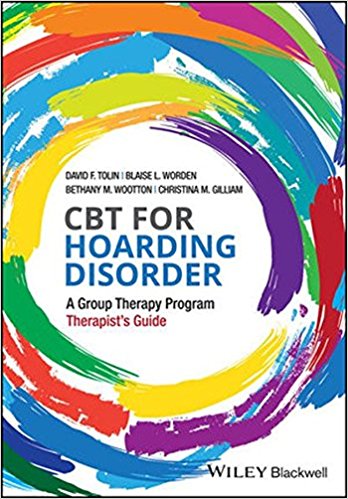
CBT for Hoarding Disorder: A Group THerapy Program (Wiley-Blackwell)
Comprised of a therapist manual and client workbook, CBT for Hoarding Disorder guides group leaders through a comprehensive CBT group program for patients struggling with hoarding disorder. Filling the need created by the inclusion of hoarding disorder (HD) as its own diagnosis in the DSM-5, this program—which was created by a group of four clinical psychologists experienced in research and treatment of problematic hoarding behavior—prioritizes experiential learning, repeated practice, skills building, and real-world discarding progress.
The therapist manual provides step-by-step, evidence-based guidance for treating hoarding with a focus on proven methods for behavior change rather than complex cognitive interventions. It contains the latest research on hoarding disorder and emphasizes the cognitive, emotional, and motivational factors involved in discarding and decision-making. The client workbook features accessible, straightforward content, including coping cards that summarize key lessons, homework assignments, motivational tools, and practice exercises for decision-making and emotion regulation skills. Easy to implement without home visits, this is a cutting-edge treatment program for professionals and group leaders of all educational backgrounds treating problematic hoarding behavior across a wide variety of treatment settings and disciplines.
The Big Book of Exposures: Innovative, Creative, and Effective CBT-Based Exposures for Treating Anxiety-Related Disorders (New Harbinger)
…a cornucopia of creative and effective exposure strategies… If you’re in search of thoughtful guidance on designing and implementing exposures, add this book to your bookshelf. You won’t regret it.
Michael Tompkins, PhD, San Francisco Bay Area Center for Cognitive Therapy
Complete with loads of creative exposure ideas and suggestions, this book is a must for any clinician working with anxious and fearful individuals.
Jonathan Abramowitz, PhD, University of North Carolina
…an invaluable resource for both beginner and advanced clinicians who use, or who would like to use, exposure therapy in their practice. This practical guide is packed with evidence-informed, innovative recommendations for designing in vivo, interoceptive, and imaginal exposures for children and adults with a range of anxiety and related disorders. A ‘must-read’ for clinicians looking to expand their repertoire of clinical skills.
Susan Orsillo, PhD, Suffolk University
This well-written, accessible book is filled with practical tips for conducting exposure therapy for the most common anxiety-related problems. This book will even help therapists to overcome their own apprehension about using exposure therapy, by addressing frequently occurring misconceptions and myths concerning exposure… essential reading for any therapist who treats anxiety disorders, obsessive-compulsive disorder (OCD), post-traumatic stress disorder (PTSD), illness anxiety, and related problems—whether they are a student, novice clinician, or seasoned therapist.
Martin Antony, PhD, Ryerson University
THE OXFORD HANDBOOK OF OBSESSIVE-COMPULSIVE AND RELATED DISORDERS, SECOND EDITION (OXFORD UNIVERSITY PRESS)
With the publication of the Diagnostic and Statistical Manual of Mental Disorders, 5th Edition (DSM-5), much has changed about the conceptualization of obsessive-compulsive disorder and its associated spectrum conditions. Breaking free from the previous category of anxiety disorders, a new diagnostic category of "obsessive-compulsive and related disorders" (ORCDs) has emerged. This new categorization has provided an opportunity to enhance our understanding of these unique disorders and to address new research questions.
The second edition of The Oxford Handbook of Obsessive-Compulsive and Related Disorders presents the latest information, from leaders in the field about the epidemiology, phenomenology, assessment, and treatment of ORCDs. The volume begins by reviewing the prevalence and profiles of obsessive-compulsive disorder, body dysmorphic disorder, hoarding disorder, trichotillomania (hair-pulling disorder), and excoriation (skin-picking) disorder. Chapter authors then discuss modern conceptualizations of the OCRDs, including neurocircuitry, genetic, behavioral, and cognitive models. From here, assessment strategies are reviewed, followed by state-of-the-science biological and psychological treatments, including pharmacotherapy, neurosurgical strategies, behavioral therapies, and cognitive therapies. Finally, the volume examines the presentation and treatment of OCRDs across cultures as well as in special populations including children and older adults.
SCIENCE-BASED THERAPY: RAISING THE BAR FOR EMPIRICALLY SUPPORTED TREATMENTS
This is the first book to analyze empirically supported treatments by using the newest criteria from the American Psychological Association's Society of Clinical Psychology, Division 12. Clinicians, scholars, and students all need to stay updated on the treatment research, and this book goes beyond providing updated treatment information by pointing readers to other useful treatment manuals and websites for continuing to stay up-to-date. The chapters, all written by prominent experts, highlight the best available evidence for specific disorders by breaking treatments down into credible components. With an emphasis on treatments for adults, chapters also share information about treatments for youth. Other variables that influence treatment are discussed, including assessment, comorbidity, demographics, and medication. Each chapter also corresponds with a chapter in the companion book, Pseudoscience in Therapy, presenting a full picture of the evidence base for common treatments.